

Overview
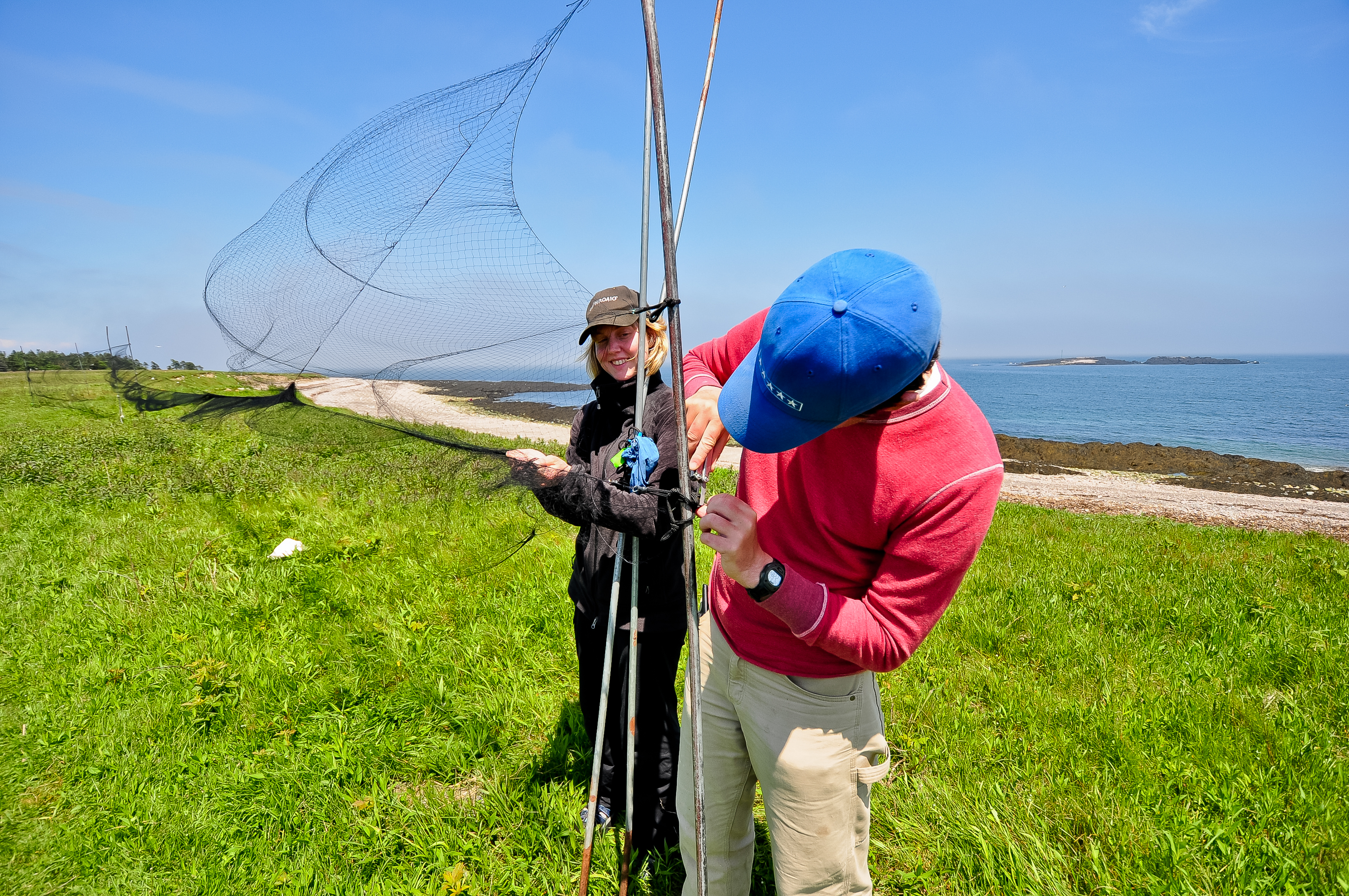
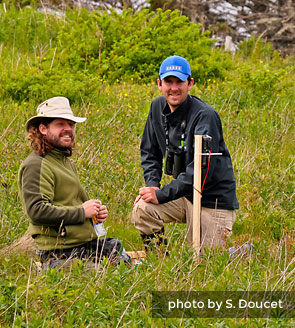
Since 2009, the Norris Lab has been conducting research on an individually marked population of Savannah Sparrows on Kent Island, an 80-hectare island in the Bay of Fundy, New Brunswick. This remarkable long-term study began in the late 1980s under the leadership of Nat Wheelwright (Bowdoin College) and now spans five decades of continuous monitoring. To date, more than 15,000 nests have been found and monitored, making this one of the longest-running studies of a migratory songbird in North America.
Each breeding season, virtually every bird in the study population is identified using unique combinations of coloured leg bands, allowing us to follow individuals from hatching through adulthood and across their entire lives. This unparalleled dataset enables us to examine how environmental conditions, social interactions, and events early in life influence physiology, behaviour, reproduction, survival, senescence, and lifetime fitness. Because multiple generations overlap within the population, we can also investigate how environmental conditions experienced by one generation influence the performance of the next.
More recently, we have expanded the project beyond the breeding season by using the Motus Wildlife Tracking System to follow individuals during migration and throughout the annual cycle. These data allow us to investigate how migration timing, movement behaviour, and conditions encountered away from the breeding grounds influence survival, reproduction, and population dynamics through carry-over effects.
In collaboration with Dan Mennill (University of Windsor), Heather Williams (Williams College), and Stephanie Doucet (University of Windsor), we are using this exceptional long-term dataset to address questions spanning behavioural ecology, evolutionary biology, physiology, and conservation. By combining lifetime records of individually marked birds with experimental approaches and emerging technologies, our recent research has examined topics including reproductive strategies, post-fledging ecology, migration, vocal communication, song learning, cultural evolution, and the demographic processes that shape population change. Together, these complementary studies provide one of the most comprehensive long-term investigations of the ecology, behaviour, and evolution of a migratory songbird while offering valuable insights into how populations respond to environmental change across the full annual cycle.
*here is a good lecture by the former director on the amazing story of how Kent Island became a biological station.
* here is a neat 3-part series on Kent Island from CBC – New Brunswick: 1. history of island, 2. living on the island, and 3. research on the island
*scroll below publications section for additional photos of Kent Island and our research.
*PDF’s of papers can be found in the “Publications” section of this website.
Publications from Kent Island Savannah Sparrow Research
30. Mueller, SD**, Wheelwright, NT, Mennill, DJ, Newman, AEM, Doucet, SM, Burant, JB**, Dobney, SL, Mitchell, GW**, Spina, HA**, Woodworth, BK** & Norris, DR. Experimental increase in fecundity does not translate into population growth in a migratory songbird. In press: Ecology
29. Spina, HA, Newman, AEM, Wheelwright, NT, Mennill, DJ, Doucet, SM, Burant, JB, Dobney, SL, Mueller, SD, Mitchell, GW & Norris, DR. 2025. Causes and consequences of within-population variation in inter-brood interval of a migratory songbird. In press: Ibis
28. Mueller, SD**, Mennill, DJ, Doucet, SM, Dobney, SL, Spina, HA** & Norris, DR. 2025. Environmental conditions and individual characteristics influence movement patterns of juvenile Passerculus sandwichensis (Savannah sparrow) throughout the post-fledging period. In press: Ornithology
27. Mueller, SD, Wheelwright, NT, Mennill, DJ, Newman, AEM, Doucet, SM, Burant, JB, Dobney, SL, Mitchell, GW, Spina, HA, Norris, DR. 2025. Population density and timing of breeding mediate effects of early life conditions on recruitment. Biology Letters 12(4):20240689.
26. Spina, HA, Newman, AEM, Wheelwright, NT, Mennill, DJ, Doucet, SM, Burant, JB, Dobney, SL, Mueller, SD, Mitchell, GW, Norris, DR. 2025. Multigenerational fitness outcomes of double-brooding: a 30-year study of a migratory songbird. In press: Behavioral Ecology.
25. Spina, HA, Norris, DR, Nong, L, Dobney, SL, Mueller, SD, Freeman, NE, Doucet, SM, Mennill, DJ, Newman, AEM. 2025. Corticosterone predicts double-brooding in female savannah sparrows (Passerculus sandwichensis). Hormones and Behavior 168:105679.
24. Mueller, SD, Wheelwright, NT, Mennill, DJ, Newman, AEM, Doucet, SM, Burant, JB, Dobney, SL, Mitchell, GW, Spina, HA, Woodworth, BK, Norris, DR. 2025. Reduced fitness of secondary females in a polygynous species: a 32-yr study of Savannah sparrows. Behavioral Ecology 36:arae093.
23. Suarez Sharma, SP, Dobney, SL, Norris, DR, Doucet, SM, Newman, AEM, Burant, JB, Moran, IG, Mueller, SD, Spina, HA, Mennill, DJ. 2024. Effects of age, breeding strategy, population density, and number of neighbors on territory size and shape in Passerculus sandwichensis (Savannah Sparrow). Ornithology 141:ukae025.
22. Williams, H, Scharf, A, Ryba, AR, Norris, DR, Mennill, DJ, Newman, AEM, Doucet, SM, Blackwood, JC. 2022. Cumulative cultural evolution and mechanisms for cultural selection in wild bird songs. Nature Communications 13:4001.
21. Hensel, ALJ, Dobney, S, Moran, IG, Thomas, IP, Burant, JB, Woodworth, BK, Doucet, SM, Newman, AEM, Norris, DR, Williams, H & Mennill, DJ. 2022. Passive acoustic monitoring provides predictable and reliable underestimates of population size and longevity in wild Savannah Sparrows. Ornithological Applications duac018.
20. Hensel, ALJ, Dobney, S, Doucet, SM, Norris, DR, Newman, AEM, Williams, H & Mennill, DJ. 2022. Microgeographic variation in bird song: Savannah Sparrows exhibit microdialects in an island population. Animal Behaviour 188: 119-131.
19. Burant, JB, Heisey, EW, Wheelwright, NT, Newman, AEM, Whelan, S, Mennill, DJ, Doucet, SM, Mitchell, GW, Woodworth, BK & Norris, DR. 2022. Natal experience and pre-breeding environmental conditions affect lay date plasticity in Savannah sparrows. Ecology 103(2) :e03575.
18. Thomas, IP, Doucet, SM, Norris, DR, Newman, AEM, Williams, H & Mennill, DJ. 2021. Choice and consequence in avian vocal learning: acoustic similarity to neighbours shapes selective attrition and territorial aggression in Savannah sparrows. Animal Behaviour 176:77-86.
17. Moran, IG, Lukianchuk, KC, Doucet, SM, Newman, AEM, Williams, H, Norris, DR & Mennill, DJ. 2019. Diel and seasonal patterns of variation in the singing behavior of Savannah sparrows (Passerculus sandwichensis). Avian Research 10: 26.
16. Mennill, DJ, Doucet, SM, Newman, AEM, Williams, H, Moran, IG, Thomas, IP, Woodworth, BK, Bornais, M & Norris, DR. 2019. Social eavesdropping on adult vocal interactions does not enhance juvenile song learning: a playback experiment on a wild songbird population. Animal Behaviour 155: 67-75.
15. Williams, H, Robbins, CW, Norris, DR, Newman, AEM, Freeman-Gallant, CR, Wheelwright, NT & Mennill, DJ. 2019. The buzz segment of savannah sparrow song is a population marker. Journal of Ornithology 160:217-227.
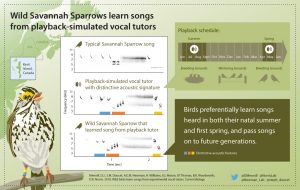
14. Mennill, DJ, Doucet, SM, Newman, AEM, Williams, H, Moran, I, Woodworth, BK, Thomas, I & Norris, DR. 2018. Wild birds learn songs from experimental vocal tutors. Current Biology 28:3273-3278.
13. Moran, I, Doucet, SM, Newman, AEM, Norris, DR & Mennill, DJ. 2018. Quiet violence: Savannah sparrows respond to playback-simulated rivals using soft songs as aggressive signals. Ethology 124(10):724-732.
12. Woodworth, BK, Wheelwright, NT, Newman, AEM, & Norris, DR. 2017. Local density regulates songbird reproductive success through effects on double-brooding and nest predation. Ecology 98:2039-2048.
11. Newman, AEM, Hess, H, Woodworth, BK & Norris, DR. 2017. Time as a tyrant: the minute, hour and day make a difference for corticosterone concentrations in wild nestlings. General & Comparative Endocrinology 250:80-84.
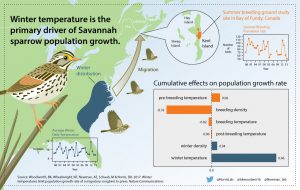
10. Woodworth, BK, Wheelwright, NT, Newman, AEM, Schaub, M & Norris, DR. 2017. Winter temperatures limit population growth rate of a migratory songbird. Nature Communications 8: 14812.
9. Woodworth, BK, Newman, AEM, Turbek, SP, Dossman, BC, Hobson, KA, Wassenaar, LI, Mitchell, GW, Wheelwright, NT & Norris, DR. 2016. Differential migration and the link between winter latitude, timing of migration and breeding in a songbird. Oecologia 181: 413-422.
8. Pakkala, JJ, Norris, DR, Sedinger, JS & Newman, AEM. 2016. Experimental effects of early-life corticosterone on the HPA axis and pre-migratory behaviour in a wild songbird. Functional Ecology 30: 1149-1160.
7. Mitchell, GW, Woodworth, BK, Taylor, PD & Norris, DR. 2015. Age-specific differences in flight duration and groundspeed are driven by wind conditions aloft: an automated telemetry study. Movement Ecology 3:19.
6. Williams, H, Levin, I, Norris, DR, Newman, AEM & Wheelwright, NT. 2013. Three decades of cultural evolution in Savannah sparrow song. Animal Behaviour 85: 213-223.
5. Mitchell, GW, Wikelski, M, Newman, AEM, & Norris, DR. 2012. Timing of breeding carries over to influence migratory departure in a songbird: an automated radiotracking study. Journal of Animal Ecology 81: 1024-1033.
4. Mitchell, GW, Guglielmo, CG, Wheelwright, NT & Norris, DR. 2012. Short- and long-term costs of reproduction in a migratory songbird. Ibis 154: 325-337.
3. Wheelwright, NT, Graf, ES & Norris, DR. 2012. Consistency in size, shape, and colouration of Savannah Sparrow eggs within and between breeding seasons. Condor 114: 412-420.
2. Mitchell, GW, Guglielmo, CG, Wheelwright, NT, Freeman-Gallant, CR & Norris, DR. 2011. Early life events carry-over to influence pre-migratory condition in a free-living songbird. Public Library of Science, One 6(12): e28838.
1. Rae, L, Mitchell, GW, Guglielmo, CG, Mauck, RM & Norris, DR. 2009. Radio transmitters do not affect the body condition of Savannah sparrows during the fall pre-migratory period. Journal of Field Ornithology 80: 434-441.
Photos of Kent Island and Savannah Sparrow Research

photo: Steph Doucet


photo: Steph Doucet


photo: Steph Doucet

photo: Steph Doucet


photo: Steph Doucet