

Overview
Protected area networks are a cornerstone of biodiversity conservation, but simply protecting land is not enough. Effective conservation requires evidence-based planning that identifies where conservation actions will have the greatest impact and how limited resources can be allocated most efficiently. Our research addresses these challenges by combining ecological theory, empirical data, and quantitative decision tools to improve conservation planning across landscapes.
Our work focuses on two complementary areas. First, we evaluate the effectiveness of protected areas and the networks they form, including developing new methods to assess habitat connectivity and identify opportunities to strengthen protected area systems. Second, we develop decision-support frameworks that help prioritize conservation actions under realistic constraints such as limited funding, time, and available habitat. By integrating demographic, movement, and migratory connectivity data across the full annual cycle, our goal is to identify the conservation strategies that will provide the greatest long-term benefits for species at risk.
Selected Publications
10. Camaclang, AE, Iyer, A, Liang, C, Giles, E, Frank, B, Currie, J, Alambo, KI, Lamoureux, J, Matchett, S, Miller, T, Norris, DR, Perron, MA, Rumney, RHM, Schueler, FW, Timms, L, Paquette, C, Hemming, V, Snider, J & Martin, TG. 2025. Nature requires investment: applying Priority Threat Management to support biodiversity and climate targets. Ecological Solutions and Evidence 6(4): e70143.
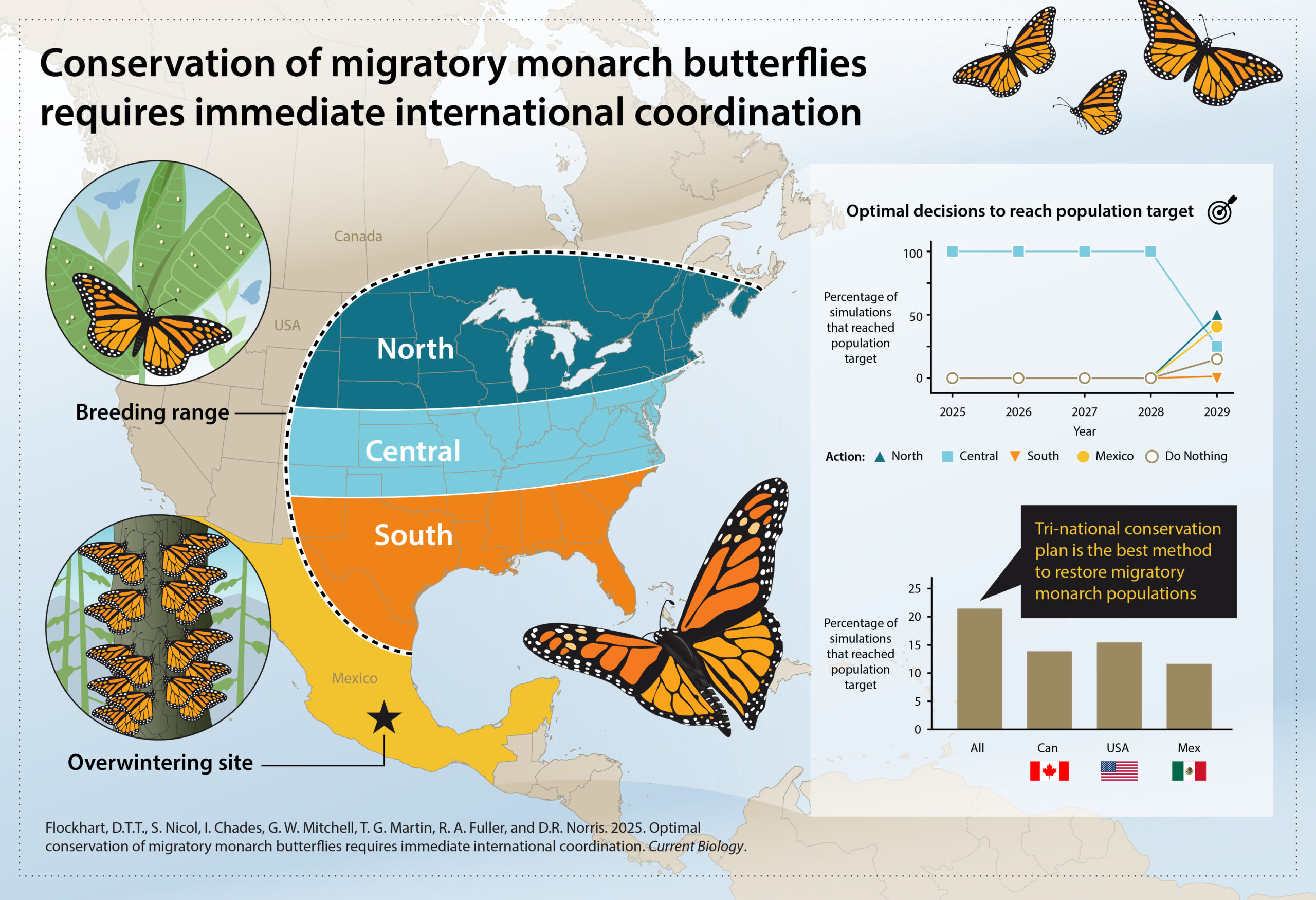
9. Flockhart, DTT, Nicol, S, Chades, I, Mitchell, GW, Martin, TG, Fuller, RA & Norris, DR. 2025. Optimal conservation of migratory monarch butterflies requires immediate international coordination. Current Biology 35(16): 4011-4018.e4.
8. Custode, LB, Pither, R, & Norris, DR. A graph theory approach to describing protected area connectivity in Canada. In revision: Conservation Science and Practice
7. Chowdhury, S, Cardillo, M, Chapman, J, Green, D, Norris, DR, Riva, F, Zalucki, MP, Fuller, RA. 2025. Protected areas fail to cover the full annual cycle of migratory butterflies. In press: Conservation Biology
6. Custode, LB, Pither, R, Moola, F & Norris, DR. 2023. A Canada-wide macro assessment of protected area connectivity. Biological Conservation 285: 110246.
5. Stevens, M & Norris, DR. 2022. A mixed methodology for evaluating use of evidence in conservation planning. Conservation Biology 36(4):e13876.
4. Custode, L, Guzzo, MM, Bush, N, Ewing, C, Procko, M, Knight, SM, Rousseau-Clair, M-M & Norris, DR. 2021. Canadian private protected areas are located in regions of higher vertebrate species richness than government protected areas. Facets 6(1):1323-1336.
3. Sheehy, J, Taylor, CM & Norris, DR. 2011. The importance of stopover habitat for developing effective conservation strategies in migratory animals. Journal of Ornithology152(S1): S161-S168.
2. Sheehy, J, Taylor, CM, McCann, KS & Norris, DR. 2010. Optimal conservation of migratory animals: integrating demographic information across seasons. Conservation Letters3:192-202.
1. Martin, TG, Chades, I, Arcese, P, Marra, PP, Possingham, HP & Norris DR. 2007. Optimal conservation of migratory species. Public Library of Science, One2(8): e751.

photo: Evelyn Norris